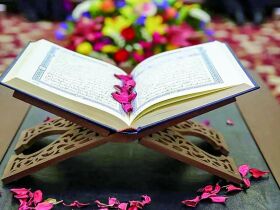
مَا کَانَ لِلْمُشْرِکِینَ أنْ یَعْمُرُوا مَسَاجِدَ اللّهِ شَاهِدِینَ عَلَى أنْفُسِهِمْ بِالْکُفْرِ أُولِئکَ حَبِطَتْ أعْمَالُهُمْ وَ فِی النَّارِ هُمْ خَالِدُونَ (۱۷)
اِنَّمَا یَعْمُرُ مَسَاجِدَ اللّهِ مَنْ آمَنَ بِاللّهِ وَ الْیَوْمِ الآخِرِ وَ أقَامَ الصَّلاَهَ وَ آتَى الزَّکَاهَ وَ لَمْ یَخْشَ اِلّا اللّهَ فَعَسَى أُولئِکَ أَنْ یَکُونُوا مِنَ الْمُهْتَدِینَ (۱۸)
It is not for such as join gods with Allah, to visit or maintain the mosques of Allah while they witness against their own souls to infidelity. The works of such bear no fruit: In Fire shall they dwell
The mosques of Allah shall be visited and maintained by such as believe in Allah and the Last Day, establish regular prayers, and practice regular charity, and fear none (at all) except Allah. It is they who are expected to be on true guidance
Proportion of verses
These two verses are among the difficult verses about which several possibilities are raised. It seems that these two verses and the three verses after them are among the verses that Hazrat Amir (peace be upon him) recited in front of the polytheists on the Day of Sacrifice, but at the same time it is not certain that these verses were revealed on that occasion, rather it is possible that they were revealed before and then recited on that day. In addition to their apparent meanings, which express a legal ruling or a fact, these two verses contain several things
Polytheists are not allowed to build mosques
It is not permissible for the polytheists to build the mosques of Allah. What is meant by building
” which means repairing the brokenness of a building.عَمَرَcomes from “یَعمروا”
because it causes the building of the body; that is, what builds the human body is the human soul عُمرUmr” is also
” , called and as long as the soul is in the body, it is said that the person has completed “Umr”. Similarly, “Umrah” is called “Umrah” because it is a means of building the house of God. It is emphasized in religion that the Hajj should be the house of God so that the means of destruction of the house is not provided
The verse includes both meanings; that is, it is not permissible for polytheists to build the house of God; they have neither the right to repair mosques nor the right to attend mosques and worship idolatrously. In some readings, "mosques of Allah" is read in the plural and in some in the singular. In the first reading, it means the Grand Mosque and the rest of the mosques, but in the second reading, only the Grand Mosque is meant. Of course, the verse was revealed about the Sacred Mosque, but it includes all mosques
شاهدین علی انفسهم بالکفر
"They are witnesses against themselves of their disbelief"
They admit that they are infidels and confess it verbally or in action, or if they maintain the appearance and say that they believe in God, but they made partners for God
أُولَئِكَ حَبِطَتْ أَعْمَالُمْ وَفِي النَّارِ هُمْ خَالِدُونَ
their actions should be in vain, and their place is Hellfire forever
Possibilities in the meaning of the verse
There are several possibilities regarding the meaning of the verse: First, it could mean news from reality, which is not true, as there are many who do not believe in God, but there are mosques, they have built. The second possibility is that this verse, along with the verse that follows it, is intended to express a religious and legal ruling; that is, from now on, the disbelievers will have the right to build it. only those who have faith in God under the conditions mentioned in the verse are allowed to build mosques and if an infidel wants to build a mosque, Muslims must prevent it. Here it should be asked what is the relevance of this legal ruling with the declaration of disgust? Since the infidels of Quraysh - due to their attribution to Prophet Abraham (peace be upon him) and Ismail (peace be upon him) who had raised the walls of the Kaaba and built the House of God - considered themselves the guardians and heirs of the Kaaba, they considered the right to build the House of God as theirs. When Islam came to power, it eliminated the issue of blood and race and introduced the real heir of every person as his intellectual heir. Although Muslims have close kinship and racial connection with Abraham (peace be upon him), and Ishmael (peace be upon him) did not have it, but since they took the idea of monotheism from them, they are their true heirs; not the infidels[1]. If we accept the second possibility, it must be said that the Prophet (peace be upon him and his family) intended to expel the infidels from the island and make it a base for the Muslims, and it was a requirement of magnanimity that this verdict announced to the infidels beforehand
According to this possibility, the meaning of the verse is that it is not lawful and permissible for the infidels to build mosques while they themselves confess their disbelief. Building mosques is to express faith and love for God. This conclusion of this legal ruling is also a declaration of disgust; because the infidels, who supposedly considered themselves entitled to build mosques because of the water for the Hajj, all their deeds have been wasted, as this verse states: “Those are the ones whose deeds have been frustrated and in the Fire they will abide forever
” "اولئِكَ حَبِطَتْ أَعْمَالُهُم و فی النار هم خالدون
And after this, they do not have the right to build mosques and they will be eternally in the Fire. Even today, if someone wants to build a mosque, he must meet these conditions
The third possibility in what was for the polytheists is that the polytheists are not worthy of building mosques and do not have this honor[2]; because those who oppose God and act contrary to His will will not benefit from building اولئک حبطت اعمالهم mosques. According to this possibility, the meaning of
is that the work of the disbeliever is fundamentally futile and useless
ما کان للمشرکین The fourth possibility is that
is intended to express the negation of the ruling from the past, not the negation of the ruling from the time the verse was revealed. The polytheists did not have such a right in the past and should not have attempted to repair mosques, and what they did in this regard was in vain and has been destroyed
Of course, when we say that there are several possibilities in the meaning of the verse, it does not mean that we have to accept only one of these possibilities, but rather that we can use all of these meanings from the verse, and on the other we can consider the same meaningsانما یعمر مساجد الله hand, in the next verse for
The conditions of mosque builders
انما یعمر مساجد الله من امن بالله والیوم الاخر و اقام الصلوه و اتی الزکوه ولم یخش الا الله
And only those who have the right to maintain the mosques of Allah are those who believe in Allah and the Last Day, establish prayer, and give zakat, and give to none but Allah. Those who have the right to maintain the mosques have five characteristics: 1. Belief in Allah; 2. Belief in the Day of Judgment; 3. Establishing prayer; 4. Giving zakat; 5. Not fearing anyone other than Allah
فعسی اولئک ان یکونوا من المهتدین"
It is hoped that these will be among the guided." The commentators have all said that "as" is for preference, but in the case of God it is for news of the future; because in the existence of God it is like this
Qualities have no path. The converted mean those who have attained the path of human happiness and perfection, not the term guidance is because they believe in God. It refers to the point to which all prophets came for guidance
The next few verses talk about genuine Islamic values and the illusory values among people
There are two points in this verse, one of which is used in the verse itself and the other in conjunction with the following verses
The first point of this verse explains that actions are like a body and a body that, if it is to be of any benefit, must have the spirit of action. The spirit of action consists of faith in God and the intention of nearness and fulfillment
Working for God is the spirit that gives life to every action. If someone does an action without faith in God and the intention of drawing closer to Him, no matter how beautiful it may be, It is true that the human body is more valuable than the body of an animal, and we do not want to take this value away from the human body, but we say that it has dignity and value when the spirit of action has entered it. In this case, the action is perfect. We see many examples of this truth in life. Many things that people do are apparently service, but they have no value in the eyes of God, this is very important to us. Perhaps someone's actions are admired; for example, he builds a mosque, but his motivation is not divine. This body of action does not bring value and dignity to him and does not cause honor. A person does not become a god in the eyes of Islamic society and the divine government. This act is not completely worthless, but it does not have full, human value
The criterion of godliness of action
With this in mind, if someone does something to save humans and society, whatever a human being does, his work is considered for God, even if the person doing it does not have this goal in mind
For example, God has commanded us to help the poor. For this reason, It is not that there should be any poor people in society; now if someone takes action to eliminate the root of poverty in society, he has fulfilled the will of God; even if he himself does not realize it. However, if someone helps the poor for a satanic purpose or non-divine motives, his action is invalid
The role of values in the fate of society
The second point of this verse, which is an addition to the following verses, is the expression of the original values in Islam. Values in every society are matters that have become more important as a result of the understanding of its individuals and the thinking of its people
In one society, knowledge may be valued and the scholar may be given precedence over others, while in another society, having colorful idols or a large clan with many sons may be valued; if this was the case in the pre-Islamic society, for example, Abdul Muttalib did not find a place in the society of that day until he had children; but when God gave him ten children, he was elected as the head of the tribe. Similar things existed in ancient societies of the Islamic era, such as Iran and still exist today. There is a close relationship between the values that govern a society and the growth and progress of that society, and naturally, the society is drawn towards what is valued in it. If power and being powerful become values in a society, everyone will pursue it; and if sexual arts appear important, that society is consciously or unconsciously driven towards lusts; Today, they attract girls, and a group of people gather and choose one of them who can attract people to them better and more interestingly, and they put a savior on her head, and the result is that every girl in society dreams of a beauty queen in her bed and wishes for her. In short, the value of something in society is actually its destiny. It defines the community. The verses address this in this regard as follows: Do you consider those who give water to pilgrims or build mosques among those who believe in God, the Exalted, and the Last Day, and strive in the way of God? These two are not equal in the eyes of God. This means that in the eyes of the Islamic legislator, your watering by the polytheists and the building of your mosques are not equal
It has no value. What is valuable in the sight of God is faith in God and the Day of Judgment and striving in His way. Of course, faith in God and the Day of Judgment is not relevant simply because of its belief in it, but because of its impact on human life. So it has both a path and a relevance
This is the model that Islam offers for recognizing authentic values, and humanity is accepted by God, the Quran, and true Islamic scholars only when it possesses these values. Of course, in the case of jihad, one form of it is fighting with the sword, because jihad has other forms that encompass all of them